
 EN
EN


Understanding Hull Design Fundamentals for Rough Seas
When navigating turbulent coastal waters or choppy open bays, the stability of your rigid inflatable boat relies heavily on its foundational hull geometry. Drawing from practical testing across various maritime conditions, watercraft featuring a deep V-hull design demonstrate superior capability in cutting through waves rather than slamming atop them. This specific structural layout redirects oncoming water downward and outward, significantly minimizing lateral rolling when operating at planing speeds. Marine engineers and naval architects consistently emphasize that an optimized deadrise angle near the transom provides the necessary lift while maintaining a secure grip during tight high-speed maneuvers. Ensuring your vessel utilizes a properly engineered hull form establishes a reliable baseline for safe handling before factoring in external equipment or weight distributions.
Optimizing Weight Distribution and Onboard Load Management
Even the most advanced watercraft will exhibit unpredictable handling if heavy cargo, fuel, or passengers are improperly positioned. Practical maritime experience shows that shifting heavy equipment forward or allowing gear to slide laterally during transit drastically alters the center of gravity. To maintain optimal handling and prevent the craft from listing to one side, operators must secure all heavy inventory along the centerline and distribute weight evenly from bow to stern. Industry safety guidelines recommend keeping lower compartments utilized for dense supplies while lighter gear is stowed higher up or in designated console lockers. Maintaining a balanced load ensures the vessel remains level, allowing the hull to engage the water surface symmetrically and absorb wave impacts effectively without sacrificing directional control.
Maintaining Proper Inflation Pressure in Buoyancy Tubes
The inflatable collars running along the perimeter of the vessel are not merely for seating or passenger comfort; they serve a critical function in dynamic stabilization. Maintaining correct air pressure inside each independent chamber prevents the hull from flexing unnaturally when encountering steep, choppy waves. Routine checks using a standard pressure gauge before launching ensure that temperature shifts or prolonged sun exposure have not compromised structural rigidity. Industry standards and manufacturer protocols highlight that properly pressurized collars provide secondary buoyancy and dampening effects when the craft rolls into a trough. Neglecting routine air pressure maintenance often results in a sluggish response and reduced buoyancy reserves precisely when reliable performance is most needed on the open water.
Utilizing Quality Marine Propulsion and Trim Settings
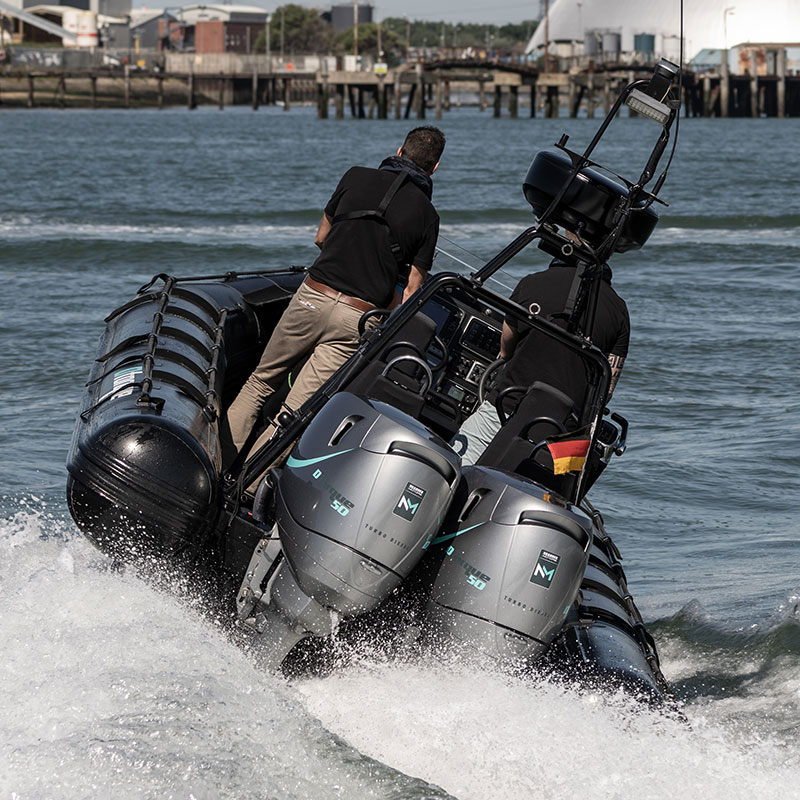
Achieving steady movement through turbulent conditions requires precise coordination between engine placement, propeller selection, and trim angle adjustments. Operating experience indicates that trimming the outboard motor down slightly when heading directly into choppy swells forces the bow downward, allowing the entry point of the hull to slice cleanly through oncoming chop. Conversely, lifting the trim too high causes the bow to bounce erratically, reducing overall control and increasing passenger discomfort. Selecting reliable propulsion setups matched accurately to the transom capacity ensures consistent thrust output without cavitation issues. Fine-tuning these mechanical variables allows the operator to maintain steady momentum and predictable steering response regardless of fluctuating surface currents.
Implementing Effective Seamanship and Safe Navigation Tactics
Technical equipment and structural adjustments must be paired with disciplined navigation techniques to guarantee maximum safety in rough environments. Professional skippers understand that maintaining a straight trajectory directly into breaking waves often creates harsh impacts, whereas approaching at a gentle angle of roughly 45 degrees softens the collision. Adjusting speed to match sea state conditions prevents the watercraft from airborne launches that stress both the hull structure and onboard occupants. Observing surrounding wave intervals and anticipating larger swells allows the operator to throttle down proactively, preserving stability and avoiding sudden loss of traction. Combining sound seamanship with a well-maintained watercraft ensures dependable navigation through demanding coastal and offshore marine environments.